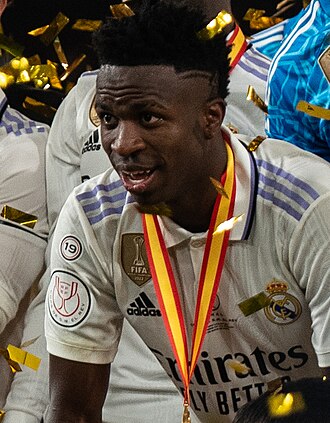
Vinícius Jr — World Cup 2026 Profile
Vinícius Jr — The Street Dancer Who Became Real Madrid's Most Dangerous Weapon
There's a specific kind of panic that spreads through a backline when Vinícius Jr picks up the ball on the left touchline and faces you up one-on-one. It's the kind of panic that makes defenders do stupid things — lunge, grab, trip, pray. Most of them end up on the grass. Most of them end up watching him sprint away toward goal. That's been the story of Vinícius José Paixão de Oliveira Júnior since he was a teenager tearing up the futsal courts in São Gonçalo, and it's the story that's going to define [Brazil](/teams/brazil.html)'s 2026 World Cup campaign.
Early Career
Vinícius was never supposed to be a slow burn. Flamengo spotted him at age six — six — and brought him into their youth setup. By 15, he was training with the first team. By 16, he was making senior appearances. The club bent its own rules to fast-track him because the talent was that absurd, that undeniable.
His breakout came in the 2017 South American U-17 Championship, where he scored seven goals and was named player of the tournament. That same year, he helped Brazil win the U-17 World Cup in India. Real Madrid had already seen enough. They triggered his €45 million release clause in May 2017 — before he'd even turned 17. The deal was done a full year before he'd arrive in Spain, and the football world collectively lost its mind. Forty-five million for a kid who'd played a handful of senior minutes? It felt reckless.
It wasn't.
Rise to Stardom
Let's be honest: the first two seasons in Madrid were rough. Vinícius arrived in 2018 as a raw, electrifying mess. The pace was terrifying, the dribbling unplayable, but the end product? Finishing was a coin flip, and not a good one. Crosses flew into the stands. Shots trickled wide. The Bernabéu groaned. Critics called him a YouTube player — all highlights, no substance.
The turnaround started in 2021-22 under Carlo Ancelotti, and it was sudden and violent. That Champions League campaign belonged to him. The goal against Liverpool in the final — a simple finish, yes, but the fact he was there, in that moment, after everything — was the culmination of a player who'd rewired his own game. He'd added composure, decision-making, and a finishing touch that had seemed impossible two years earlier. Fifteen goals and five assists in La Liga that season. Five goals in the Champions League. Not a YouTube player anymore.
Then came 2023-24, and Vinícius went supernova. Twenty-four goals in all competitions. The hat-trick against Dortmund in the Champions League semifinal second leg. Two goals in the final against, yes, Dortmund again at Wembley — including that ridiculous run from the halfway line that left half the team grabbing air. He won the Champions League Final MVP for the second time. At 23, he was already being mentioned in the same breath as the greatest to ever wear the white shirt.
The Ballon d'Or snub in 2024 — losing to Rodri — became fuel. Vinícius didn't hide his frustration, and frankly, he had a point. But he also used it. Every time he steps on the pitch now, there's a chip on his shoulder the size of the Christ the Redeemer.
World Cup History
Here's the painful part for Brazilian fans. Vinícius's World Cup résumé is thin, and not by choice.
2022 in Qatar was supposed to be his tournament. Tite built the attack around Neymar, but Vinícius was the electric outlet on the left, the player who'd stretch defenses and create the space Brazil's stars needed. He scored against South Korea in the round of 16 — a slick, composed finish in that 4-1 demolition that had everyone believing. But then the quarterfinal against Croatia happened, and Brazil's campaign died on penalties after 120 minutes of frustration. Vinícius was subbed off in extra time. He didn't take a penalty. He couldn't.
One World Cup. Four appearances. One goal. That's the stat line, and it gnaws at him.
He wasn't part of the 2018 squad — too young, still at Flamengo. So 2026 represents his second crack at this, and given how the last one ended, you can bet every neuron in his body is locked onto the United States, Mexico, and Canada.
2026 World Cup Outlook
[Brazil](/teams/brazil.html) head into 2026 with Vinícius as the undisputed focal point of the attack. Neymar's career is winding down — he'll be 34 by the time the tournament starts, and his body has been betraying him for years. This is Vinícius's team now. The armband might not have his name on it, but the pulse of the attack does.
The question isn't whether Vinícius will be good. He'll be 25, in his physical prime, coming off arguably the most dominant club run of any forward in Europe. The question is whether Dorival Júnior — or whoever's in charge by 2026 — can build a system that maximizes what he does best: isolating defenders in space, attacking on the break, and punishing high lines.
Brazil's qualifying campaign was bumpy. Inconsistent results, questions about identity, the usual post-2022 hangover. But Vinícius kept producing, and the tactical shift toward playing through him rather than around him became obvious. He's no longer the supporting act.
The bigger concern is mentality. Vinícius has been the target of racist abuse in Spain for years, and his response — fighting back, speaking out, refusing to be silenced — has been heroic but also draining. The 2026 World Cup, played across three countries with massive Latino and Brazilian diaspora populations, might be the most welcoming environment he's played in since leaving Rio. That freedom could unlock something special.
Playing Style & Stats
Vinícius is a left winger who plays almost exclusively on the left side but drifts inside with a relentlessness that turns structured defenses into chaos. His game is built on three things: acceleration, close control at speed, and an almost sadistic ability to unbalance defenders before they can set themselves.
The step-over sequence is his signature — not the Cristiano version, all flash and width, but a tighter, quicker iteration designed to shift the defender's weight before the actual move. He doesn't do step-overs for the camera. He does them to create a half-yard of space, and then he's gone.
Key stats (club career through 2024-25):
- **Real Madrid:** 90+ goals, 70+ assists in 250+ appearances
- **Champions League:** 2 titles, 2 Final MVPs
- **La Liga titles:** 2 (2021-22, 2023-24)
- **Top speed:** 35 km/h (among the fastest in world football)
- **Dribbles completed:** consistently top 3 in La Liga since 2020
- **International:** 5+ goals for Brazil, key starter since 2021
What separates him from other speed merchants is the improvement in his final ball. The early years of wayward crosses and scuffed shots are gone. He can finish with both feet now — still stronger on his right than you'd expect for a left-sided player — and his decision-making in the box has gone from chaotic to clinical.
Defensively, he's never going to be a press monster. That's not his job. His job is to exist on the left flank as a permanent threat, the player opponents plan their entire defensive shape around, and he does that as well as anyone in the world right now.
FAQ
Has Vinícius Jr won the Ballon d'Or?
Not yet. The 2024 vote — where he lost to Rodri — remains controversial. Many in the football world felt Vinícius's Champions League heroics and overall impact made him the clear winner. He's the favorite heading into future cycles, and a dominant 2026 World Cup would end the debate.
Why did he stay at Real Madrid instead of moving to the Premier League?
Multiple clubs — including Liverpool and Chelsea — circled Vinícius during his difficult early seasons. He stayed because Real Madrid invested in him when he was 17, and because Ancelotti's arrival gave him the tactical freedom he needed. In 2024, he signed a contract extension running to 2029. He's not going anywhere.
What's his role in the Brazil national team for 2026?
He's the main man. With Neymar's decline and the emergence of a new generation (Endrick, Rodrygo, Paquetá), Vinícius is the player [Brazil](/teams/brazil.html) will build their World Cup around. Expect him cutting in from the left, with license to roam, and the entire attacking pattern flowing through his positioning and movement.