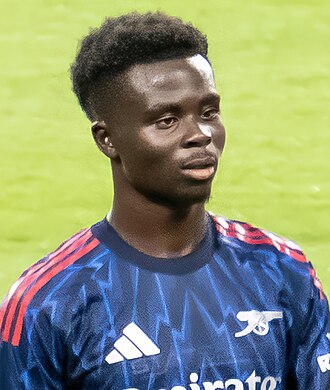
Bukayo Saka — World Cup 2026 Profile
Bukayo Saka
Bukayo Saka is the kind of player who makes you believe football still belongs to the kids. At 24, he's already carrying Arsenal's attack, walking into any England XI, and doing it all with a grin that suggests he's genuinely enjoying himself — a rarity in the modern Premier League grind. If [England](/teams/england.html) are going to win anything worth winning in the next decade, Saka is probably the reason why.
Early Career
Born in Ealing, West London, to Nigerian parents, Saka joined Arsenal's Hale End academy at age seven. That's not a typo — seven. Most kids that age are still figuring out which foot to kick with. Saka was already on the pathway.
He broke into the first team under Unai Emery in 2018-19, making his Europa League debut against Vorskla Poltava at 17. It was quiet, unassuming, very Saka. No social media announcements, no agents leaking stories to the press. He just turned up and played.
The 2019-20 season was the real launchpad. When injuries ravaged Arsenal's squad, Saka filled in at left-back, left wing-back, and right wing — sometimes in the same week. His versatility wasn't just convenient; it was genuinely impressive. He registered 12 assists across all competitions that year, including the pass for Nicolas Pépé's goal in the FA Cup final win over Chelsea. Not bad for a teenager who'd barely started a game in his natural position.
Arsenal handed him the number 7 shirt in 2021. Some shirts carry weight at that club. Saka wore it like it was made for him.
Rise to Stardom
The 2021-22 season was when Saka stopped being "one for the future" and became the present. He scored 11 league goals and added 7 assists, carrying an Arsenal side that was still finding its identity under Mikel Arteta. He was named Arsenal's Player of the Season. He was 20.
But the real leap came in 2022-23. Saka hit 14 goals and 11 assists in the Premier League as Arsenal pushed Manchester City to the wire in the title race. That season, he scored in six consecutive home league games — the youngest Arsenal player to do so since Thierry Henry in 2000. Let that sink in. Henry comparisons at 21.
The 2023-24 campaign confirmed his elite status: 16 goals and 9 assists in the league, 20 goals across all competitions, and a third consecutive Arsenal Player of the Season award. He was also shortlisted for the Ballon d'Or — not winning it, obviously, but making the 30-man shortlist at his age tells you where he sits in the global conversation.
What makes Saka different from other young wingers who burn bright and fade? Consistency. He's missed just 4 league starts through injury across three full seasons. In a sport where "impact sub" is the default trajectory for young attackers, Saka has been a nailed-on starter for three years running.
World Cup History
Saka's World Cup story is, so far, a single chapter — but what a chapter.
Qatar 2022 was his tournament, even if [England](/teams/england.html) fell short in the quarter-finals against France. Saka scored twice in the 6-2 demolition of Iran in the group stage opener, becoming the youngest English goalscorer in a World Cup since Michael Owen in 1998. His first goal — a composed first-time finish from a Jude Bellingham layoff — was the kind of finish that looks simple until you try it at 80,000-seater pace.
He started every game in the tournament, operating on the right flank and giving England genuine width and penetration. Against Senegal in the round of 16, he was unplayable — scoring the third goal and constantly dragging defenders into places they didn't want to go. His link-up with Phil Foden and Harry Kane was the most fluent attacking pattern England produced all tournament.
The France quarter-final was cruel. Saka won the penalty that Kane scored to make it 1-1, then won another penalty that Kane skied over the bar at 2-1 down. England lost 2-1. The narrative fixated on Kane's miss, but Saka's performance — winning both spot-kicks through pure directness and close control — was arguably England's brightest spark.
Prior to Qatar, Saka's major tournament experience included Euro 2020, where he was a key contributor off the bench and, heartbreakingly, one of the three players who missed penalties in the final shootout against Italy at Wembley. The racist abuse that followed could have destroyed a lesser character. Saka responded by becoming undroppable.
2026 World Cup Outlook
By the time the 2026 World Cup kicks off, Saka will be 24 — squarely in his prime years. For [England](/teams/england.html), he's no longer a bright young thing; he's a pillar.
The expanded 48-team format means more group-stage games and potentially deeper runs for top sides. That suits Saka, whose fitness record and durability make him built for tournament football. He doesn't pick up knocks. He doesn't need rotating. You write his name on the teamsheet and forget about it.
The tactical question for Thomas Tuchel (or whoever's in charge by 2026) is where Saka plays. He's been predominantly a right winger under Arteta, cutting inside onto his left foot, but he's equally effective on the left or as an inside-forward in a more fluid system. England have Foden, Cole Palmer, and Jarrod Bowen competing for wide spots, but Saka is the one who'd start in every top national team in the world right now.
If there's a concern, it's that Saka has never played a World Cup on home(ish) soil — the 2026 tournament being co-hosted by the US, Canada, and Mexico means long travel, varied climates, and unfamiliar pitches. But Saka's adaptability has always been his calling card. He played left-back as a teenager. He'll cope with a flight to Dallas.
The honest read? If England go deep in 2026, Saka will be the main reason. He's the best right winger in the country and arguably top three in Europe. It's his time.
Playing Style & Stats
Saka is a press-resistant, ball-carrying winger who thrives in one-on-one situations. His low centre of gravity and close control make him nearly impossible to dispossess in tight spaces — a skill he honed in Arsenal's academy and sharpened under Arteta's possession-based system.
He's not a classic pace merchant. His acceleration is good, not blistering. What kills defenders is his manipulation of body shape: he leans one way, shifts the ball the other, and he's past you before you've shifted your weight. It's vintage winger play, updated for the era of inverted formations.
Key stats (Premier League, 2023-24):
- 16 goals, 9 assists in 35 appearances
- 2.7 key passes per 90
- 2.1 successful dribbles per 90
- 84% pass accuracy
- 14 big chances created
Career totals (all competitions, as of 2024-25):
- 60+ goals for Arsenal
- 40+ assists for Arsenal
- 12 goals, 7 assists for England
His defensive work rate is the underrated part. Saka tracks back, presses intelligently, and rarely leaves his full-back exposed. In a tournament setting where every transition counts, that two-way contribution is gold.
FAQ
Has Bukayo Saka won the World Cup?
No. His only World Cup appearance came in 2022, where [England](/teams/england.html) were eliminated by France in the quarter-finals. Saka scored twice in the tournament and started every match.
What position does Saka play?
Primarily right winger, cutting inside onto his stronger left foot. He's also played on the left flank and at left-back earlier in his career. His versatility is one of his biggest assets — he's genuinely effective in multiple positions, not just filling in.
Is Saka the best winger in England?
Right now, yes. There's a legitimate debate with Phil Foden and Cole Palmer, but Saka's consistency, durability, and output across three full seasons give him the edge. He's started over 90% of Arsenal's league games since 2021. That reliability, paired with genuine match-winning quality, makes him the first name on the teamsheet.